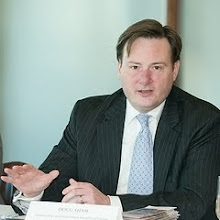
Good morning, and welcome to The George Washington University’s Elliott School of International Affairs. I’m Doug Shaw, as associate dean here at GW’s Elliott School, and I am grateful for your participation in today’s workshop on Teaching the Nuclear Fuel Cycle: What do Policy Makers, Practitioners, and the Public Need to Know? I am particularly pleased to welcome Assistant Secretary of Energy for Nuclear Energy Peter Lyons, who I will introduce in a moment.
This event, and the Nuclear Policy Talks series of which it is part, responds to the mission of GW’s Elliott School to make the world a better place by conducting research on global human challenges, educating a new generation of leaders to respond to those challenges, and engaging the policy community facing those challenges every day.
Today’s discussion is particularly urgent.
We live in a dynamic moment in the understanding of the nuclear fuel cycle. Just last week in a speech at the Nuclear Security Summit in Seoul, South Korea, President Barack Obama said “We all know the problem: The very process that gives us nuclear energy can also put nations and terrorists within the reach of nuclear weapons,” and responded to that challenge by calling, among other things, for “an international commitment to unlocking the fuel cycle of the future.” In a short essay in The Huffington Post yesterday, President of the John D. and Catherine T. MacArthur Foundation President Robert Gallucci responds to the urgent danger of nuclear terrorism by urging a ban on the production of fissile materials that would end the separation of plutonium from nuclear spent fuel and the enrichment of uranium to high levels. In yesterday’s Global Security Newswire, Elaine Grossman reported that the U.S. Nuclear Regulatory Commission has deferred action on a petition from the American Physical Society urging that an assessment of proliferation risk should precede the licensing of each new enrichment or reprocessing facility. Informed opinions are converging on these important topics, but disagreements remain framed by differences in the perspectives of different expert communities. At GW, we are committed to helping to bring these communities into contact to better understand these important issues.
For nuclear security policy to progress on a productive and informed path, it is imperative that experts communicate effectively across their respective spheres of knowledge. Dr. James Doyle of Los Alamos National Laboratory identifies more than a dozen disciplines that constitute “nuclear security science.” Beyond the academy, communication between the policy, military, technical, business, scientific, and advocacy communities focused on nuclear technology is constrained, and there are few venues for the development of consensus or shared understanding. Efforts to assess proliferation risk and safety of nuclear energy choices are making progress, but this highly specialized knowledge is often developed and held within disciplinary and affinity group silos. These efforts do not yet respond to the need for greater communication across disciplines and communities.
Absent communication among these diverse expert groups, policy makers are constrained from the development of the best options to promote safety and security while the public is constrained from the development of opinions adequate to democratic decision making. Without this communication, efforts to educate a next generation of nuclear security leaders who can synthesize the insights of these various perspectives are impeded.
Responding to this problem requires a focused effort to combine the insights of technical, industrial, policy, and interdisciplinary scholarly communities around the proliferation implications of fuel cycle choices. The development of interdisciplinary nuclear curricula would mitigate these challenges by educating members of the next generation of nuclear security experts.
GW is taking on this challenge. The Nuclear Policy Talks series of which today’s event is part has brought more than 200 nuclear policy experts to campus in the last three years, ranging from Elliott School alumnae and New START negotiator, acting undersecretary of state for arms control and international security Rose Gottemoeller, to Senator Richard Lugar, to United Nations Secretary General Ban Ki-Moon to former Trident ballistic missile submarine commander turned GW Professor of Mechanical and Aerospace Engineering Murray Snyder. We are engaged in research on this topic, the 2010 MIT Press book Going Nuclear: Nuclear Proliferation and International Security in the 21st Century, co-edited by the Dean of GW’s Elliott School, Michael Brown, reflects. We are also developing new course offerings in this area, including a new graduate course this fall on nuclear materials science for non-technical students, to be offered by Professor of Chemistry and International Affairs Christopher Cahill, working on a grant from the U.S. Nuclear Regulatory Commission.
We believe today’s discussion will support and enhance all these efforts. We will begin with remarks from Assistant Secretary Lyons, followed by a panel discussion on proliferation risk and nuclear fuel cycle choices, featuring prominent experts Sharon Squassoni, of the Center for Strategic and International Studies, who is a leading participant in the ongoing study at the National Academies on proliferation risk in the nuclear fuel cycle, Joseph Pilat from Los Alamos National Laboratories, and Seth Grae from the innovative nuclear fuel design firm Lightbridge, whose business model makes economic use of the differential in proliferation risk between fuel cycle choices. Over lunch, former head inspector of the International Atomic Energy Agency, Dr. Olli Heinonen, will share his expert perspective on the timely issue of Iran’s nuclear program. In the afternoon, a second panel will focus on the relationship between the reprocessing of spent nuclear fuel and global security, featuring the legendary expertise of Dr. Richard Garwin, the perspective of George Mason University Professor Allison MacFarlane fresh from service on the Blue Ribbon Commission on America’s Nuclear Future, and the industry perspective of Dororthy Davidson, Vice President of Nuclear Energy, Renewables, and Science Programs at AREVA Federal Services. Our third panel will reflect the work of a world-class team of experts, led by Dr. Michael Rosenthal of the Domestic Nuclear Detection Office of the Department of Homeland Security, that has recently completed a textbook manuscript on nuclear safeguards. In addition to Dr. Rosenthal, Ambassador Norm Wulf and Dr. Linda Gallini of the State Department will also address the crucial issue of safeguards. We are excited about this program and believe it to be unique, and are grateful to you for your participation.
So, without further discussion, it is my great honor to introduce The Honorable Dr. Peter B. Lyons, Assistant Secretary of Energy for Nuclear Energy. Dr. Lyons was confirmed by the Senate to this position a year ago next week, following two years of service as the Principal Deputy Assistant Secretary for Nuclear Energy.
The Honorable Peter B. Lyons was sworn in as a Commissioner of the Nuclear Regulatory Commission on January 25, 2005 and served until his term ended on June 30, 2009. At the NRC, Dr. Lyons focused on the safety of operating reactors and on the importance of learning from operating experience, even as new reactor licensing and possible construction emerged. He emphasized that NRC and its licensees remain strong and vigilant components of the Nation's integrated defenses against terrorism, and was a consistent voice for improving partnerships with international regulatory agencies. He emphasized active and forward-looking research programs to support sound regulatory decisions, address current issues and anticipate future ones. He was also a strong proponent of science and technology education, recruiting for diversity, employee training and development programs, and an open and collaborative working environment.
From 1969 to 1996, Dr. Lyons worked in progressively more responsible positions at the Los Alamos National Laboratory. During that time he served as Director for Industrial Partnerships, Deputy Associate Director for Energy and Environment, and Deputy Associate Director-Defense Research and Applications. While at Los Alamos, he spent over a decade supporting nuclear test diagnostics. Before becoming a Commissioner, Dr. Lyons served as Science Advisor on the staff of U.S. Senator Pete Domenici and the Senate Committee on Energy and Natural Resources where he focused on military and civilian uses of nuclear technology, national science policy, and nuclear non-proliferation. Dr. Lyons has published more than 100 technical papers, holds three patents related to fiber optics and plasma diagnostics, and served as chairman of the NATO Nuclear Effects Task Group for five years.
Dr. Lyons was raised in Nevada. He received his doctorate in nuclear astrophysics from the California Institute of Technology in 1969 and earned his undergraduate degree in physics and mathematics from the University of Arizona in 1964. Dr. Lyons is a Fellow of the American Nuclear Society, a Fellow of the American Physical Society, was elected to 16 years on the Los Alamos School Board and spent six years on the University of New Mexico-Los Alamos Branch Advisory Board.
Please join me in welcoming The Honorable Peter Lyons.
Friday, April 6, 2012


Wednesday, May 11, 2011
Introductory remarks at Global Security Engagement Conference
Good morning, my name is Doug Shaw and I am an associate dean here at The George Washington University’s Elliott School of International Affairs.
It is an honor and a pleasure to welcome you to our campus for this important discussion of “Emerging Opportunities and Challenges in Global Security Engagement Programs. I’m grateful to all of you for participating in this important work, and particularly to the committee of conference organizers that has worked for several months to make this event possible. I am especially grateful to Ambassador Bonnie Jenkins, the State Department’s Coordinator for Cooperative Threat Reduction Programs for her vision to convene us here to explore a path forward toward Global Security Engagement.
The
Our location has been an important asset in the growth of the
Our mission is a simple but important one: to create knowledge about important global issues, educate future leaders, and engage the public and policy communities to make our world a better place. In no topical area is this mission more urgent than the emerging field of Global Security Engagement and we are grateful that this conference and your presence will contribute to our ongoing efforts in knowledge creation, education, and policy engagement.
In terms of knowledge creation, GW’s Center for Nuclear Studies is home to one of the largest concentrations of nuclear physicists in higher education.
Nuclear physics has a distinguished history on this campus. In 1934, then GW President Cloyd Hecht Marvin decided to strengthen physics by hiring George Gamow who would become renowned for developing the big bang theory. The following year, they hired Edward Teller who would become the father of the American hydrogen bomb. And at GW on January 26, 1939 Nobel Laureate Niels Bohr reported the splitting of the uranium nucleus with a release of two hundred million electron volts of energy, heralding the beginning of the nuclear age. This important work in physics continues today, as the continued support of the Energy Department for our work and the International Atomic Energy Agency’s adoption of a description of neutron-proton interactions developed at GW’s
We are also grateful to have you here because this event will help engage young people in the important work of Global Security Engagement.
I am especially grateful to Ambassador Jenkins for making room for several
Finally, we are grateful that this conference will help us better engage the policy community.
GW’s Institute for Security and Conflict Studies hosts one of the most active event series on proliferation prevention in the world. Just over two years ago, renowned nuclear strategist Sir Lawrence Freedman visited the
So, thank you all, again for participating and I look forward to a rich and productive discussion that will inform your work and our three part mission of research, teaching, and policy engagement.
Thursday, January 13, 2011

Friday, October 15, 2010
Draft outline of my spring course on Nuclear Proliferation and Nonproliferation
Substantive comments welcomed.
1: Technical requirements of nuclear proliferation
PART I: Nuclear Proliferation
2: Assessing nuclear proliferation
3. Explaining and predicting nuclear proliferation, part I
4: Explaining and predicting nuclear proliferation, part II
5. Security, alliance structure, and nuclear proliferation
6. Non-state actors, smuggling, and terrorism
7. Implications of a nuclear revival
PART II: Nuclear Nonproliferation
8: The global norm and the NPT bargain
7: Structuring international nuclear commerce
8: Safeguards and physical protection
10: Latency, Detection, and Warning
11: Enforcement and interdiction
12: Cooperative threat reduction
13: Counterproliferation by force
14: Security implications of the global nuclear system
Thursday, October 7, 2010
A Dangerous Gap in Nuclear Education
Neglect of the study of nuclear weapons in higher education has resulted in a gap in the specialized knowledge needed today. In 2009 remarks at the
[i] Bryan Bender, “Alarm over shortage of nuclear experts,” Boston Globe, April 3, 2010, link: http://www.boston.com/news/nation/washington/articles/2010/04/03/alarm_over_shortage_of_nuclear_experts/
[ii] James Doyle, Los Alamos National Laboratory, “Nuclear Security as a Multidisciplinary Field of Study,” link: http://www.lanl.gov/orgs/ndo/n4/documents/safe_ed_laur08-1896.pdf
[iii] General Kevin Chilton , “2009 Deterrence Symposium Opening Remarks,” July 29, 2009, link: http://www.stratcom.mil/speeches/24/2009_Deterrence_Symposium_Opening_Remarks
Friday, August 6, 2010
Teaching Nonproliferation: Hands on, Online, and Followed on
Last month I attended a terrific meeting on the topic of “Nuclear Security Education: The Intersection of Policy, Science, and Technology” hosted by the University of Tennessee Howard H. Baker, Jr. Center for Public Policy and Oak Ridge National Laboratory, sponsored by the National Nuclear Security Administration (NNSA).
I learned a lot, and came away convinced of three specific elements that should be included to prepare the next generation of nuclear nonproliferation practitioners. Nuclear security education should be hands on, online, with follow on.
Nuclear security education should be hands on, with experiential learning opportunities, physical exhibits, and field trips. Simulations of International Atomic Energy Agency (IAEA) Board of Governors meetings and State Evaluation Exercises have been pioneered at the Monterey Institute’s James Martin Center for Nonproliferation Studies and, with interdisciplinary teams of nuclear engineering and international affairs students at the Nuclear Security Science Policy Institute at Texas Agricultural and Mechanical University (TAMU). Listening to former IAEA safeguards inspectors discuss the tools of their trade, I became intensely curious about those tools – and my students have responded very well to radiochemistry Professor Christopher Cahill’s efforts to bring uranium and detection equipment into the classroom. Field trips to the National Laboratories or working nuclear facilities suggest great promise.
Nuclear security education should be online, with great videos of lectures, simulations, and virtual reality experiences are available now. TAMU’s Nuclear Safeguards Education Portal contains top-shelf lectures on the fuel cycle; GW’s Elliott School has a Web Video Initiative with several great talks featuring a series of Nuclear Policy Talks by Rose Gottemoeller, Ellen Tauscher, Jayantha Dhanapala and others, and, of course, the Massachusetts Institute of Technology has a wealth of offerings in Nuclear Engineering, Physics, and Political Science. The Henry L. Stimson Center just introduced a great online game called “Cheater’s Risk” that allows students to explore proliferation pathways interactively in the context of a reacting international community trying to detect their efforts and Google Earth can help explore any location on the planet. Virtual reality (VR) is an exceptionally promising area – Los Alamos National Laboratory (LANL) is working on VR safeguards inspections that could be tailored for generic facility types or for specific facilities to prepare inspectors for specific inspection activities (or be displayed on their handheld or through a monocle during the inspection itself) and a simulation of detection of nuclear material on a container ship may also be in the works. Security considerations may keep some of these tools offline, but TAMU’s Bill Charlton reports the University of Denver has a nuclear reactor available in Second Life open to all.
Nuclear security education should be followed on, with linkages to additional education, professional societies, and job opportunities. NNSA sponsored six summer courses through the Next Generation Safeguards Initiative this summer at the National Laboratories and universities and the Center for Strategic International Studies Project on Nuclear Issues (PONI) is one of a growing number of networking opportunities for young people interested in learning more about nonproliferation. The Institute of Nuclear Materials Management is an important vehicle of validating and extending nonproliferation education. NNSA’s Nonproliferation Graduate Fellowship Program is one great pathway to a career in the field.
Great food for thought as those teaching on these topics prepare our fall courses.
Friday, July 16, 2010
A Walk the Senate should take

Last night's
Lee Blessing's Pulitzer-nominated play casts two people with the awesome responsibility to reduce the risk of nuclear war through negotiated arms reductions. This brilliant and well-acted play highlights the urgent necessity and daunting challenge of responding to the danger posed by nuclear weapons just in time, as the Senate Foreign Relations Committee is scheduled to take its most important vote on arms control in a generation by the end of the month. Statesmanship will be at a premium in consideration of this landmark agreement, as the new Strategic Arms Reduction Treaty (START) between the United States and Russia moves to the Senate floor where a two-thirds majority -- and therefore bipartisan cooperation -- will be necessary to ratify it.
In the play, negotiators John Honeyman and Andrey Botvinnik represent the Cold War adversaries, the
Some argue that nuclear weapons make war too horrible for any "rational" leader to risk. Blessing's Soviet presciently observes how globalization complicates this delicate logic: "Once we only had to be rational in English and Russian." Today we must do so in more languages and perhaps with terrorists who have no territory or population for us to threaten. And as the Gulf oil spill attests, accidents happen. Nuclear weapons endanger human civilization.
Blessing's heroes offer hope by rising from their seats and opening their imaginations to each other. History agrees. In the years following the collapse of the Soviet Union, arms negotiators moved their work from
A generation later, over 22 thousand nuclear weapons remain. This spring,
Still, survival requires that someone take up this work, and the brave few who do have each other. Why should arms negotiators become friends? Andrey Botvinnik argues "because someone has to."
The
Not all of them will, but you still can. Three of the five performances of this important production are already sold out, a few tickets remain for the 11:30 a.m. show on Saturday (July 17) and the 3:00 p.m. show on the following Saturday (July 24). Get your tickets now.
Subscribe to:
Posts (Atom)